Skip to Content

Aszaneé Truss

Rachel Wenrick

Azsaneé Truss

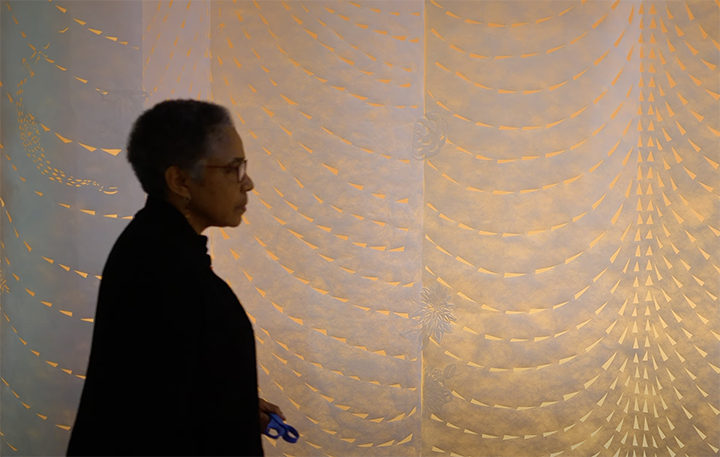
Photo: Tiffany R. Smith

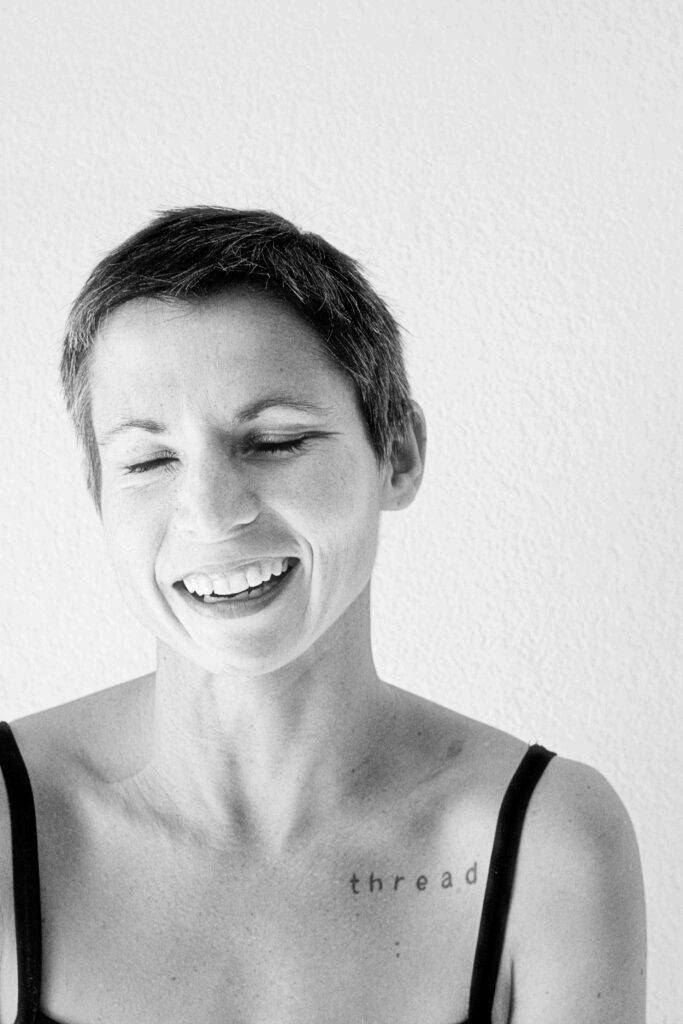
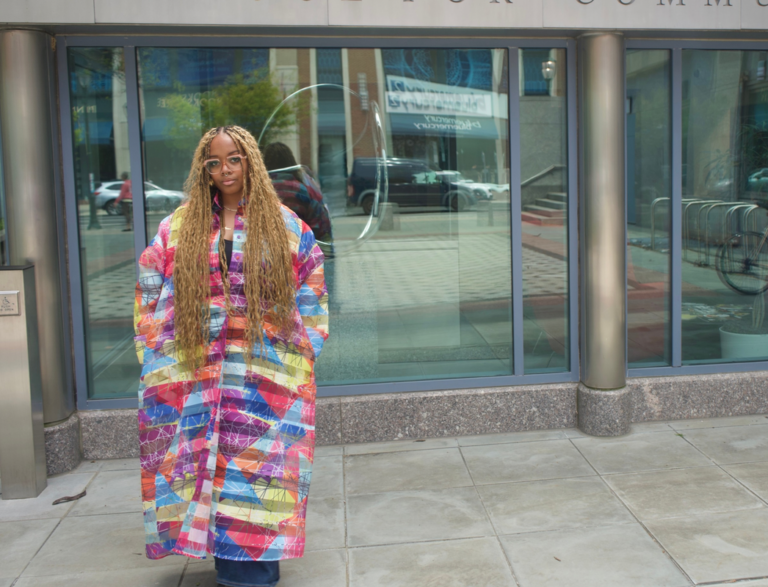
Azsaneé Truss, who describes herself as a Thinking Artist, is the Gilbert Seldes Multimodal Postdoctoral Fellow in the Center for Experimental Ethnography. Truss earned a PhD from the Annenberg School for Communication. Below she describes two collages related to her time and work in Philadelphia and at Penn and answers a few questions about her trajectory as a scholar-artist.

Questions
Who is Azsaneé Truss? What are you about?

Thinking artist is the most… all-encompassing term that I can use for who I am. And I must always credit bell hooks with that term. I’m also a daughter, an auntie, a friend, a community member, a sister—all the other things, in addition to that. I see everything I do as being for my community, however narrowly or expansively that might be defined in a particular project.

Can you describe your arts pathway to this moment?

I grew up in Delaware, and I was a dancer, primarily. Had you asked 16-year-old Azsaneé where I would be today, she would’ve said dancing or artistic directing a company. She would look at my life now and say: What happened to the original plot of the movie?

I went to Cab Calloway School of Arts, which was great—a lot less traumatic than your average high school experience. Then I went to the University of Maryland for undergrad. I ran the ballet company there, but my parents–even though they were artists–didn’t see dance as a viable career path, so I had no idea what to major in. I jumped around for a good year and a half before ending up majoring in business information systems. After college, I worked in New York City for EY—a multinational professional services firm. I soon realized corporate life wasn’t for me. So in the second year, I started applying to grad school.

I went to Teachers College at Columbia, thinking I would marry my tech background with my passion for education. I ended up in the Media and Social Change Lab (MASCLab), trying to record a podcast for a class, and I met Professor Lalitha Vasudevan. Eventually, I came with MASCLab to the Screen Scholarship Media Festival here at Penn—which now I am planning. It’s all very full circle.

In the MASCLab, I found out about this thing called multimodal scholarship—which asserts the validity of the use of expressive forms in knowledge creation. And, suddenly, there was my art again. I was making collages in the Lab, putting them up on the walls, making podcasts, and just doing the thing. Lalitha told me there was a professor I should work with, a dean at Penn in the Communication Department, John Jackson, who’s now the provost. She said I should apply. And so I ended up in Annenberg in a department that was open to me doing multimodal scholarship. So that was kind of how my research got room to breathe.

What does the University of Pennsylvania mean to you right now–the place, the people?

Right now I’m a postdoc in the Center for Experimental Ethnography (CEE). I came to Penn because there was this interesting enclave of Black women doing… well, the work of worldbuilding. There are people like Krystal Strong, Grace Sanders-Johnson, Margo Crawford, and of course Deb Thomas, Director of the CEE, who I work under now. She’s a dancer, and she thinks about embodiment in these really remarkable ways. I saw so many people whose careers I would want to emulate… like, if mine ends up looking remotely like theirs, then I will feel like I’ve done something.

More than that, these professors attracted other people like me. So I have, beyond thought partners, friends here. That’s been the biggest gift that I’ve gotten from being at Penn: meeting people who do really radical, decolonial, anti-colonial work–Black women, queer people–in a truly interdisciplinary community. They are in spaces shaking things up in ways that I learn a lot from. Not only at CEE in the Anthropology department, but also in CAMRA, within the Black Cultural Studies Collective, which is technically housed in English. In the Fred Moten “Undercommons” sense, I have found it nurturing to be with other people who are using the available resources to sustain our communities in creative ways.

Collage from exhibition 'What World' by Azsaneé Truss

‘What World’ collage Azsaneé Truss

This collage is part of a two-part series–a diptych I was working on for an exhibition titled What World? that I curated over at The Arts League, a local, small arts non-profit on 42nd and Spruce. The point of the exhibit was to reflect on both the promises and perils of this moment. Ultimately, we live in a collapsing empire, and the exhibition explored what that means. What are the possibilities after this? So, I divided the room in two: this collage was the center on one side, and the companion piece that’s more techno-dystopian was on the other. It felt disingenuous to explore the hope without exploring the despair.
What are you currently working on? What excites you?

I’m planning the Screening Scholarship Media Festival which is really exciting. Almost 15 years ago, folks came together and formed the Collective for the Advancement of Multimodal Research Arts (CAMRA), which was able to support students who were doing the type of work that I do. It was a way to make a space where we commune and we ask: how do we collaborate to get institutions to recognize multimodal scholarship? SSMF is this cool opportunity to curate performances and to bring together community to share ideas and think together. Although planning it is a bit of a beast, it’s exciting to help create a sustainable model to make sure that SSMF continues to exist. I just got our keynote speaker confirmed: Vashti Dubois at The Colored Girls Museum in Germantown. The theme is Portals, and The Colored Girls Museum is nothing if not a portal. Kayla Childs, who goes by the stage name Black Buttafly, is performing as the opener. And Katleho Shoro, who’s a poet and student in the Anthro department, will be closing.

Another ongoing project that I’ve been working on for the past couple of years is a podcast called Groovin’ Griot. It’s about movement and embodiment in knowledge-making and storytelling, and I make it with my dear friend and collaborator, OreOluwa Badaki. She’s actually an alum of Penn GSE and a Research Scholar in the Digital Futures Institute at Teachers College. I think the project is really representative of everything we stand for as scholars.

I’m also working on a project at the Annenberg Center with ArtPhilly and the Sachs Program. I’m doing exhibition design for an exhibit that’s a companion to a performance that Penn Live Arts is commissioning. The choreographer Tommie-Waheed Evans is working with dancers from his company, Philadanco, and from the Martha Graham Dance Company. He’s drawing on American Document, which is a performance that Graham choreographed in 1938. The performance is titled, In Case of Fire, Speak.

This interview has been edited and condensed

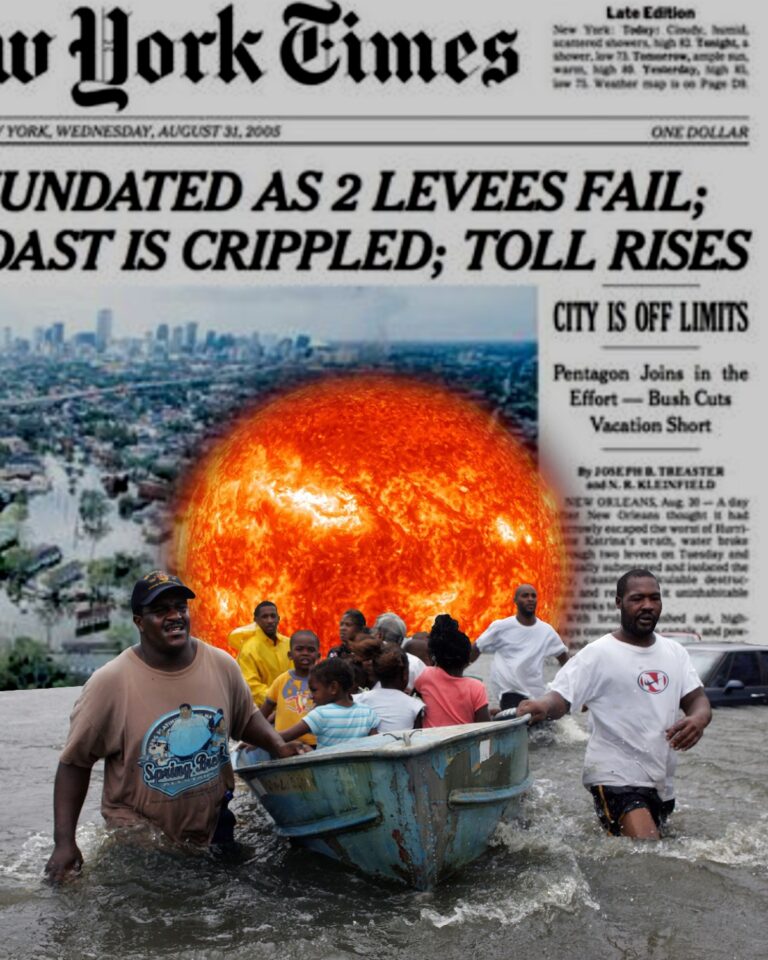
Collage from Azsaneé Truss dissertation work on conspiracy theorizing.

Collage from Azsaneé Truss dissertation work on conspiracy theorizing.

This collage is a part of my dissertation work on conspiracy theorizing among Black folks, in America but also globally. My dissertation asserts that there is a different valence, oftentimes, to the conspiracy theories that Black folks develop. It’s not delusional: we’re often trying to make sense of the ways in which a system that has historically oppressed us might be oppressing us now, asking how the powers-that-be might be shaping our lived reality.
This collage is looking at conspiracy theories related to Hurricane Katrina among Black folks in New Orleans. Originally, I went into this chapter thinking I would only be demonstrating the logics of the theories they developed, not necessarily exposing truth. People suspected that the New Orleans government had exploded the levees, that they weren’t breached naturally. Then, as I was researching, I find out that the Louisiana government had done just that during the Mississippi floods in 1927 to protect richer neighborhoods. And potentially again during Hurricane Betsy in the 60s. So there was precedent. This wasn’t merely an extension of the abstract realities of environmental racism and gentrification, but an idea related to fact. And they never gave anyone reparations for this. So when you get to Hurricane Katrina in 2005, suddenly these theories don’t sound so crazy.