Skip to Content

Al Filreis

Arts at Penn

Al Filreis

Photo: Alli Katz

Al Filreis is the Kelly Family Professor of English and Director of the Center for Programs in Contemporary Writing. He is founder and Faculty Director of the Kelly Writers House at 3805 Locust Walk. With Charles Bernstein, he co-founded and co-directs PennSound, the world’s largest archive of recordings of poets performing their work. Aside from teaching modern American poetry, he has offered a series of courses on twentieth-century American decades, and another on the literature of the Holocaust.
Who are you? What are you about beyond your CV?

I am a scholar-professor who ended up at a major research university having expected to have my entire career at a small college where working with students was the primary function. So, I’m a bit of a funny animal at a university. I’m sure I’m not alone. But what floats my boat is working with and responding to students, especially outside the curriculum.

What was your arts pathway to where you are now?

Well, my father was a World War II veteran who went to a randomly chosen university on the GI Bill, and majored in ceramics. He was an inspiration for me. When I went to college, I was drawn to literature and creative expression generally, and my dad was very supportive. There’s no singular moment when I realized that writing and writers were my main interest, but I have used my passion for writing and writers to convene people. So you might say my primary passion is convening people—and writers give us good subject matter for convening.

To understand a piece of writing, you ought to be with others. Writing is a social act. A poem in particular is a social act: it has an audience implicitly, and the audience co-creates the meaning of the poem. That generates a pedagogy which in turn generates a community and that creates the possibility or the necessity for calling people together to say: “Can we do this together?” This of course is true of many areas of life. Science, for instance—you need a research team in order to figure out where you’re going wrong. But famously, and maybe even infamously, in the area of the arts, there is an assumption that (to take a striking example) you’re out on Long Island and you’re Jackson Pollock and you’re dripping on canvases and there’s really nobody else involved in what is a solo, and presumably unique, performance. Well, that’s not true, or at least not typical.

Sam Filreis

Sam Filreis

The University of Pennsylvania—what has it come to mean to you?

Well, this is my 40th year at Penn. I’ve met a lot of great people. It’s a university whose main flaw, of course, is that it is predominantly pre-professional. Students come here expecting that they will acquire professional skills, but that is not what universities should be providing, in my opinion. So I’ve been a resistant thinker for 40 years, thinking that and supporting my students to think that way. Of course, for them, there is something of an advantage to being met at a party with skepticism, to meet people who say, “Well, what are you going to do with that?” Or: “Oh, that’s nice.” To be treated like an ornament: “Oh, that’s cute. We’ll have one of those.” Being met that way activates institutional energy and strategizing.

Penn has been very good to me. The Kelly Writers House is 30 years old this year, and it was not easy to create it and sustain it against the odds. It’s unique at universities. Three cheers for Benjamin Franklin for founding a university that could tolerate the helter-skelter creation of little entities around the campus in the name of experimentation!

How is the Writers House unique? Well, there are a few things…

One—everything is free and open to everyone. We don’t even have a card swipe at the door.

Two—we prefer talking to being talked at. We believe that speaking with is the only way to become really more human. So everything we do is a seminar or a workshop. Everything. That in itself is not completely unique, but the House is definitely an island in a sea of lecturing.

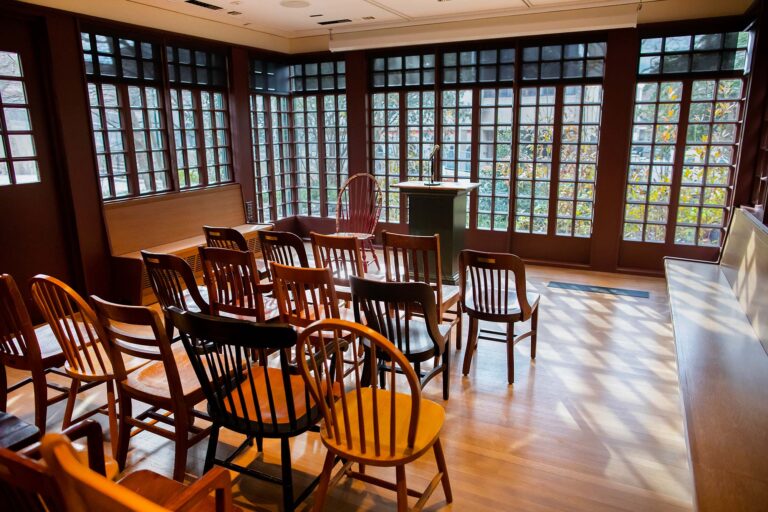
Three—we believe that architecture is destiny. At a university campus, especially one this old, if they give you a house, take it and stay. When you choose to enter the Writers House there’s only one reason you’re there—to be part of a writing community. There will be a literary problem to solve, and it will require your engagement.

Four—we don’t have an MFA program. We are perhaps the only well-established writers’ community at a major university that doesn’t, and that absence changes everything. If we had an MFA, it would have created a first tier of people who need to be served, who get primary access to courses, to visiting writers—for networking and job getting and book selling. We don’t go in for that. Thus staff, our West Philadelphia neighbors, alumni, children, seniors, retirees: these people are all invited and have access equally.

Five—curriculum. The Writers House is not curricular. When a faculty member walks in there, they are not presiding over grade getting.

And sixth—finally—is food. Everything revolves around food. The more, the better. It draws people together after a program’s workshop or a reading performance. People gather around in the dining room—yes, we have a dining room. Architecture is destiny. Build a dining room, and people will come and eat and talk. They’ll get to know each other. So there’s endless, endless amounts of food and coffee and tea.

Al Filreis and Sophia Hall

Al Filreis and Sophia Hall at Kelly Writers House. Credit: Alli Katz

Can you tell me about your current project or excitement?

Well, my students are amazing. I so admire and love my students. I teach courses inside the Writers House. Creating a course in that space is a very special thing. Currently, I’m a third of the way through teaching the Kelly Writers House Fellows course, which has been operating now for 26 years. I’ve taught it 24 times. It’s a great project because we bring eminent writers in after a month of our studying, reading, discussing. And we’re in the middle of one such visit now, with the poet Elizabeth Willis. And there is nothing quite like it an extended in-person visit.

One of the other classes that I teach is a course on representations of the Holocaust. I’ve taught it for 40 years. From the first year, 1985, that course has always required students to watch the entirety of Claude Lanzmann’s film, Shoah, nine-and-a-half hours. My students are required to watch it all on a Sunday. My colleague, Sophia DuRose, and I have decided to write a book about—not Shoah—but about the people who watch Shoah, those who have watched Shoah in this course for 40 years. The tentative title is Seeing Shoah. The highlight of the process will be a group of 15 or so people returning to the Writers House in October: some in their early 60s, some just 23 years old, and they’re going to come together. They don’t know each other. They do know the course and the film, and we’re going to watch it again together. Then we’ll do a group interview with them, and these interviews will feed the chapters of the book.

What have I missed that you want to say?

Every answer I’ve given you has been a kind of advocacy. I don’t think I have anything more to advocate.

Thank you.