Skip to Content

Bloomberg Connects the Collection: Lynn Smith Dolby

Arts at Penn

Lynn Smith Dolby, Director Penn Art Collection

Lynn Smith Dolby, Director Penn Art Collection, Credit: Eric Sucar

This spring The Penn Art Collection joined the ranks of  Bloomberg Connects, a free app that allows anyone with a smartphone to explore audio and visual content and guides to over 1250 museums, galleries, sculpture parks, gardens, and  cultural spaces around the world. Since the launch, the site has had nearly 1000 unique users.

Lynn Smith Dolby, Director of the Collection, is enthusiastic about the prospect of increased outreach, online or otherwise. The university’s fine art collection, though extensive, is not housed in a brick-and-mortar museum. Instead, it is dispersed in buildings and in public spaces all over the campus. Dolby offered a bit of cataloguing history: “In 1973, a facilities administrator named Joseph Looby and two students went around campus and recorded what they thought were important artworks on index cards—that’s how the inventory started.” There are currently over 9,000 artworks inventoried, and both Dolby and Molly Sampson (the Collections Manager) are eager to introduce students, faculty, alumni, visitors, and neighbors to this decentralized treasure.

The opportunity to marry The Penn Art Collection’s outdoor sculpture garden (along with highlights from the larger collection) with the Bloomberg Connects app was a no-brainer, especially as it offered a chance to involve current students in the cataloguing process. Of all the collection’s materials, the public art holds a particular place in Dolby’s heart. She has personally given traditional sculpture tours every homecoming and alumni weekend for eight years. For her, this is a way to meet alumni and hear their recollections of a changing campus. But Penn campus is also in the heart of West Philadelphia, open to visitors and neighbors—Dolby thought, “Why not use the sculptures’ public presence as an opportunity to connect with the larger community?”

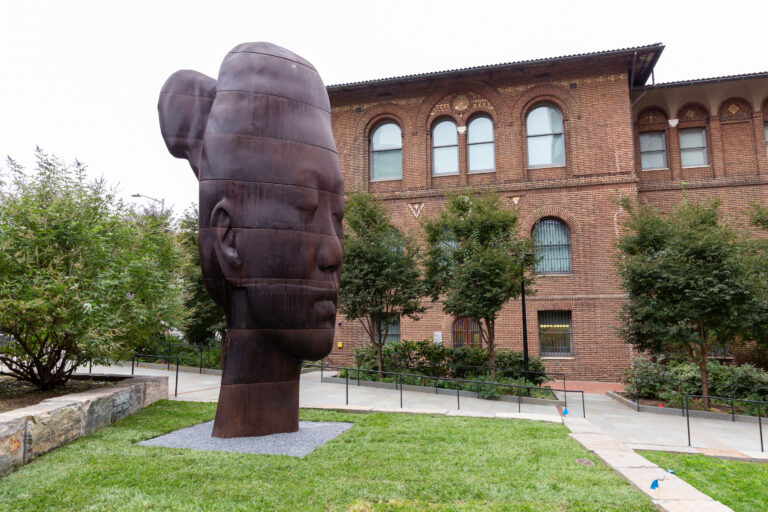
Rui-Rui, Credit: Eddy Marenco for Penn Today

In creating the information for the app, Dolby partnered with  Gwendolyn DuBois Shaw, Faculty Director of the  Arthur Ross Gallery (also on the app!) and her fall 2025 Art History Graduate Seminar. Each of DuBois Shaw’s students selected a sculpture and then produced an academic article on their chosen piece as well as recording 1-3 minutes of material that would end up on the app. When Ava Cappitelli, a Masters Student in Art History, met Dolby through the class and got to tour the collection’s files in preparation for her article, she began to understand its scope and was floored: “I was blown away–I didn’t realize that we had that much.” Cappitelli wrote about the newly acquired Rui Rui: a 23-foot tall, 19,608-pound cast-iron bust created by the Spanish sculptor Jaume Plensa. After completing her research and creating the material for the app, Cappitelli was asked to deliver the opening remarks at the sculpture’s dedication in November.

A bronze “tombstone” plaque graces every public sculpture on campus, but it contains only basic information: name, title, and date of the work. In 2008, the university Architect’s Office created an audio program called  Discover Penn–a phone number that offers recordings on some sculptures, campus trees, and buildings. To Dolby, Bloomberg’s program was a way to create even more access: “It’s free for users to log on and use, it’s free for partners to update and upload their information.” Using the phone app helps people to interact with the art on their own terms, in their own time: it allows for impromptu self-directed tours–tours curated by Penn student research. In this way, the students’ interactions with the public art and their documentation for Bloomberg Connects becomes another layer of dialogue between art and the community in which it is situated.

Cascode, Credit: Christopher William Purdom

An example: Sarabelle Vilfort, a second-year PhD student chose to learn and write about Eto Otitigbe’s installation  Cascode, a work commissioned as part of Penn Engineering’s Amy Gutmann Hall and completed in 2024: “Otitigbe partnered with  Dashboard, a creative arts nonprofit, to create questionnaires aimed at understanding how members of the community interacted with their environment… By transforming community reflections on nature into art, Cascode echoes Amy Gutmann Hall’s commitment to human-centered, environmentally conscious technology.”

Despite their modest length, the students’ descriptions serve to illuminate the work behind the art—connecting artist to audience, and place to purpose.

Only about thirty pieces were uploaded to the site in the initial run, but Dolby is excited for the work to continue: “That was phase one, and we accomplished it with these amazing Penn students, creating a wonderful curricular experience for them. So we’re wondering, what’s the next phase? Because there are collections in all these  different buildings across campus waiting to be discovered.”