- Public Trust
- Interdisciplinary
- Faculty in the Arts
Aaron Levy

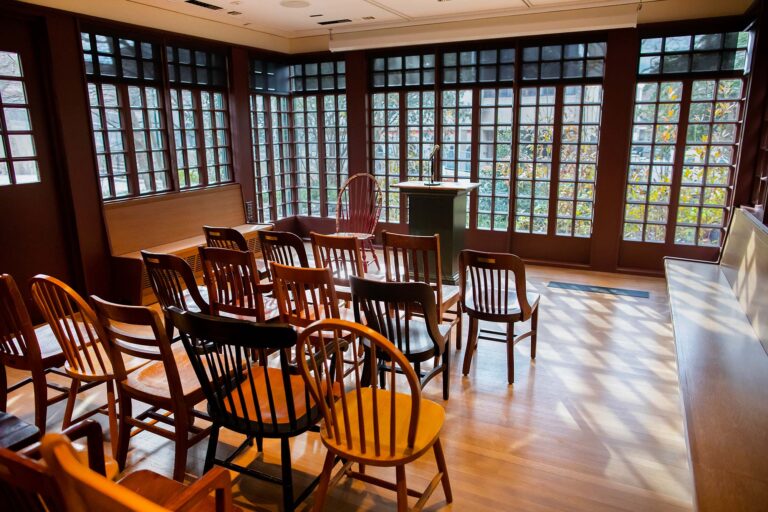
Aaron Levy at the Penn Medicine Listening Lab, Credit: Eddy Marenco
-
Previous in the series
On Collective Intelligence: Stephen Kieran and James Timberlake
- Next in the series
Why don’t you tell me a little bit about yourself and your relationship to the arts?
I was first drawn to conceptual practices of the 1960s and ’70s—artists who were inviting their viewers to see art as a process of becoming and experimenting with objecthood and memory. Over time, I became invested in public art and architecture, and then to socially engaged practices and the ways in which art can advance healing both individually and communally.
Throughout, the same questions keep returning: How do we care for each other? How do we hold onto grief? How do we listen across difference? What agency do we have within structures that often make us feel powerless? The arts play an important role in helping people feel recognized and less alone. They amplify the voices of those around us, respond to social urgencies, and advance justice in society. Penn is uniquely positioned to support these kinds of inquiry.
Also, could you offer a bit about your history in the arts, your arts pathway to here and now? Your undergrad degree was in English?
That’s right. I was an undergraduate English major here at Penn, and I studied in Fisher-Bennett Hall–the same building where, nearly thirty years later, I have an office. That long-term relationship to a field and a community has been a kind of anchor. It’s also exciting to feel you have a role to play in an institution’s transformation.
As a student, I primarily identified as a poet and photographer. In the years afterward, I found a home within the writing community and experimental media. I ultimately found my way to art history and curatorial work — drawn to how art can bring people together and deepen conversation around social issues.
Curatorial work is deeply collaborative and nurtures community in creative ways. It invites us to dwell on experiences that deepen our understanding of ourselves and the world, and to affirm our responsibility toward one another.
What has Penn come to mean to you over your time here?
Who we are reflects our interactions with others, which is an understanding with roots in classical antiquity and in the origins of the modern university. Through dialogue with others our perspectives shift, and we reckon with our place in the world. The culture here at Penn reflects this spirit, which is essential in these times of increasing isolation and polarization. On our campus, it is possible to imagine a clinician and a poet in dialogue, or a patient and a curator in conversation, or even those of different political persuasions.
Our disciplines are less siloed than ever before, and the arts have played an important role here in bridging our university’s diverse communities. They connect disciplines and the schools—and they lead us back to our lived experiences and to those within the broader Philadelphia community and the Commonwealth of Pennsylvania. The arts strengthen our bonds in a world where many feel isolated, divided, and alone.

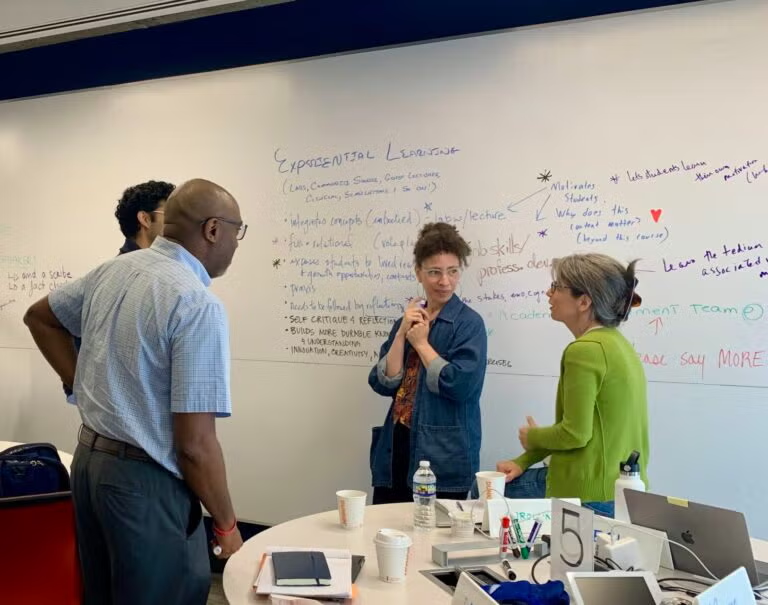
Class photo from The Literature of Care course, Credit: Eric Sucar
Could you tell me about a current project or excitement for you?
I’ve been working with two colleagues, Daniel Tucker and Abigail Satinsky, on a project called Curating Engagement, together with the Wagner Foundation. We began by organizing a retreat in 2025 that gathered about 50 curators, artists, and community organizers in Philadelphia and across the nation to reflect on the challenges of engaging communities, and on the creativity and innovation found in everybody’s distinct practices. Out of that retreat, a publication emerged. We hope to carry this work forward through future retreats and publications.
We’re thinking about the possibilities for field-building and sustaining a community of practitioners in the current landscape. It feels urgent to be asking: How can we be in greater solidarity with others? How can we nurture those individuals who are ethically engaging communities? How can we sustain this work across different institutional scales and structures, and varied understandings of whose needs should be prioritized in this moment?
There isn’t one way to be creative, curate, or engage communities. We’re stronger as a community when we’re able to learn about each other’s respective practices, while also acknowledging the differences inherent in each of them.
These questions also animate my teaching. In my Spiegel-Wilks Seminar, offered in collaboration with the Barnes Foundation, students engage directly with modern and contemporary art to explore how art can foster healing, compassion, and a mutuality of care. In The Literature of Care, we take up similar questions through writing, asking how exposure to the arts and humanities makes us more receptive to human vulnerability and more capable of responding to the suffering of others. These are other registers for the same inquiry.

Public Trust photo from Magnum Photos project with Jabriya Calabrese, Credit: Constance Mensh
Something you’d like to leave us with?
Those of us situated within institutions often struggle to acknowledge the wisdom and creativity inherent in individuals, neighborhoods and communities. Art offers us a window into different ways of understanding and helps us to treasure our individual and communal stories. Mine is not an object-oriented way of thinking but rather a relational one. This sensibility informs the work that I do in the health system at Penn Medicine through projects such as the Penn Medicine Listening Lab or Rx/Museum, where we approach art and listening as a unique pathway to receiving each other’s lived experiences.
For nearly twenty-five years at Public Trust, I’ve also sought to advance a methodology and spirit of partnership. Students, the faculty, and staff on campus are our collaborators and partners. Rather than defining our curatorial platform and agenda internally, we’ve tried to flip that model and think about how we can support the visions and aspirations of the community. The programs we present at Public Trust emerge from that desire to platform and amplify voices and issues that don’t always find expression in institutional settings.
Oftentimes in academia and museums, we tend to define the arts narrowly and assume the artist must carry a professional pedigree or have a validated practice. I hope we can advance a vision as a university community that both honors art historical frameworks as well as an approach that finds value in vernacular expressions of cultural heritage. This approach has helped me arrive at what I hope is a more democratic understanding of how we honor creativity.
Thank you so much for your time.
Writer/Editor
Kirsten Kaschock
Kirsten Kaschock is a poet and novelist whose background in dance impacts her work—she consistently addresses intersections between language and body. She holds doctorates in English literature and dance studies. Kaschock is the author of seven poetry books and two novels and has received fellowships from the Pew Foundation, the Pennsylvania Council on the Arts, Vermont Studio Center, Subcircle, and the Summer Literary Seminars.