- Center for Experimental Ethnography
- Interdisciplinary
- Faculty in the Arts
Deborah Thomas

Deborah Thomas R. Jean Brownlee Professor of Anthropology, Director of the Center for Experimental Ethnography
- Previous in the series
- Next in the series
Could you tell us who you are beyond your resume?
Both artistically and as a scholar, I am, at heart, a creator and assembler of archives. These archives might be narrative, material, performative, sonic, or visual, and my practice of assembling them has been geared toward opening new imaginative and speculative spheres of thought and action in which people might connect with each other across both time and space. My hope is that in so connecting, we might think through our own relations to these archives, and that we might elaborate new foundations for sociality and liberation. For me, therefore, archiving is a decolonizing practice that is necessarily public, relational, and dialogic.
Can you describe your arts pathway to this moment? What role(s) have the arts (writ large) played in your journey thus far?
Prior to my life as an academic, I was a professional dancer with the New York-based Urban Bush Women, a company that is committed to using the performing arts as means of addressing issues of social justice and encouraging civic engagement, and that brings the untold stories of disenfranchised people to light through dance from a woman-centered perspective and as members of the African Diaspora community. I had become interested in attending graduate school as the result of the program of grassroots work that we had developed called Community Engagement Projects. These were six- to twelve-week residencies during which we would work, at a community’s invitation, in conjunction with various grassroots organizations using dance, theatre, and music to catalyze the kinds of changes they wanted to see within their own neighborhoods. The small individual and collective breakthroughs engendered by our working process inspired my commitment to participating in and theorizing the performing arts as means to catalyze social change. As a result, when I entered graduate school in 1992, I was interested in gaining a deeper understanding of the issues surrounding these kinds of processes within the context of post-colonial nationalism. My scholarly work, then, began as a continuation of my commitments to bridging the arts, knowledge production, and critical public engagement. In my own work on the afterlives of imperialism, I have sought to think across genres, which means that in addition to books, I have created films, exhibits, and other materials in collaboration with many others.
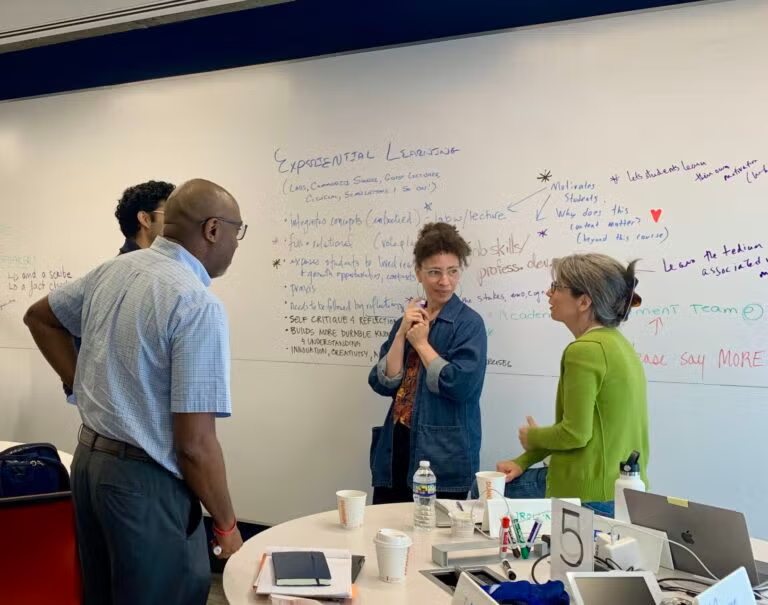
These commitments also undergirded the founding of the Center for Experimental Ethnography in July 2018, for which I serve as Director. The CEE emerged from a multi-year collaboration among faculty across eight of Penn’s twelve schools who believe that multi-modal research practices transform how we conduct research, how we generate and disseminate knowledge, how we train students, and how we remain accountable to the communities in which we interact and through which our research circulates. Our mission is to support ethical, engaged, and experimental multi-modal research that is generated ethnographically. Toward this end, the CEE coordinates scholarship, research, and public partnerships related to multi-modal work practices; consolidates those activities in which we (and our students) are already engaged; and grows these generative connections by hosting Visiting Scholars, coordinating workshops and conferences, supporting undergraduate and graduate research, engaging with arts and community-based institutions throughout Philadelphia, and forging connections with other like-minded institutions worldwide. We see creative practice as intellectual work that necessarily historicizes the inequalities that pervade our society, and that develops interventions through collaborative and participatory work. A basic premise that underlies our efforts is that an expanded and multi-modal definition of what counts as scholarship will help lead to a more diverse university community, a community in which artistic practice is a cornerstone not only for engaged and participatory social justice work, but also for the reimagining and transformation of the university as a whole.

Jonkonnu dancer at Tambufest, a kumina festival co-organized with Junior “Gabu” Wedderburn and Nicholas “Rocky” Ferguson in Jamaica. Credit: Junior “Gabu” Wedderburn.
How did you arrive at the University of Pennsylvania? What does this place and its people mean to you?
I arrived at Penn after four years at Duke University in the Department of Cultural Anthropology, and then two years as a postdoctoral fellow at Wesleyan University’s Center for the Americas. Penn is a big tent and an easy space to find collaborators across disciplines and schools. This is what has been so enriching about the Center for Experimental Ethnography, as we’ve been able to connect easily with other faculty and students who have a creative practice at the heart of their research process. Now that Tim Rommen is Vice Provost for the Arts, I know that all the work we have been doing across our various spaces will be elevated, and I look forward to seeing the new synergies that develop!
What are you currently working on? What do you see as the potentials that may ripple out from this project?
I am working on a project I’m currently calling “From Island to Island to Island…” Part speculative ethnographic non-fiction, part soundscape, part performance, part memoir, and part multi-modal installation, the project addresses the legacies of lesser-known middle passages through and from Africa, Asia, and the Americas to ask complicated questions about travel, conscription, labor, spiritual world-making, and self-narration. How do we excavate lesser known inter- and intra-continental circulations? In what ways have these circulations posed a threat to power as much as they have served to consolidate it? How have they reconfigured questions of race and belonging, time and place? And if empire has conscripted us into a particular kind of modernity, can return be a mode through which to practice repair? Right now, we have an audio-visual prose-poem in the “Dispossession in the Americas” exhibit at Wrightwood659 (in Chicago), and the rest of the project will build from that. Who knows, I might even end up back on the stage!

The reburial site for those “Liberated Africans” exhumed during construction for the St. Helena airport, organized and presented by the St. Helena Heritage Trust. Credit: Deborah Thomas.
Writer/Editor
Kirsten Kaschock
Kirsten Kaschock is a poet and novelist whose background in dance impacts her work—she consistently addresses intersections between language and body. She holds doctorates in English literature and dance studies. Kaschock is the author of seven poetry books and two novels and has received fellowships from the Pew Foundation, the Pennsylvania Council on the Arts, Vermont Studio Center, Subcircle, and the Summer Literary Seminars.